The Current View
A lengthy downtrend in sector prices had given way to a relatively stable trajectory after mid 2013 similar to that experienced in the latter part of the 1990s and first few years of the 2000s.
The late 1990s and early 2000s was a period of macroeconomic upheaval during which time sector pricing nonetheless proved relatively stable.
Relative stability suggests a chance for companies genuinely adding value through development success to see their share prices move higher. This was the experience in the late 1990s and early 2000s.
Still vulnerable cyclical conditions were aggravated in the second half of 2015 by a push from investors worldwide to reduce risk. Sector prices were pushed to a new cyclical low. These conditions were reversed through 2016 and 2017 although sector prices have done little more than revert to the 2013 levels which had once been regarded as cyclically weak.
With a median decline in prices of ASX-listed resources companies through the cycle of 89%(and 30% of companies suffering a decline of more then 95%), the majority of stocks remain prone to strong 'bottom of the cycle' leverage in response to even slight improvements in conditions.
Has Anything Changed?
The strength of the US dollar exchange rate since mid 2014 had added an unusual weight to US dollar prices. Reversal of some of the currency gains has been adding to commodity price strength through 2017.
Signs of cyclical stabilisation in sector equity prices has meant some very strong ‘bottom of the cycle’ gains.
Funding for project development has passed its most difficult phase with the appearance of a stronger risk appetite.

Resource Sector Weekly Returns

Market Breadth Statistics

52 Week Price Ranges

Equity Markets

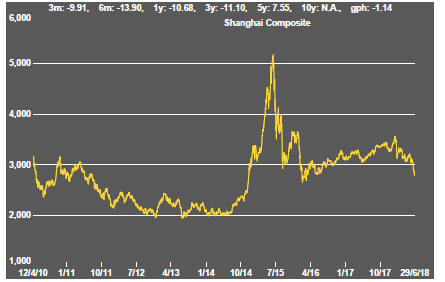


Trade policies loomed larger as a market influence during the week as the US administration appeared intent on following through with its threats to apply first and second round tariffs against contrives with which the US has a trade deficit.
Complaints are emanating from even those industries in the US which could be expected to benefit from trade deficit cutting measures.
Emerging country markets continued to feature as sources of weakness as concerns rose that global growth was losing momentum. The Chinese market was conspicuously weaker as worries about trade policy changes became more prominent, although the Shanghai market does not have the deep links to the Chinese national economy as equity markets in advanced economies.
At the end of the week, US markets appeared to be weathering the trade policy uncertainties but the momentum has clearly slipped and it is hard to see what might act as a catalyst for a change in direction in the near term.
Market volatility measures are moderately higher with investors seemingly taking policy uncertainties on trade at the same time as a Federal Reserve commitment to tighten policy in their stride, at least for the time being.
Resource Sector Equities


Material sector prices remain within their uptrend while hovering near the lower bound of the range.
Sector returns were slightly positive among the market leaders with Australian stocks benefitting form the recently weaker Australian dollar.
Smaller stocks again underperformed the market leaders.
In the Australian context, the industrial sector lost ground against the resources stocks which benefitted from the weaker currency and from higher crude oil prices.
Interest Rates


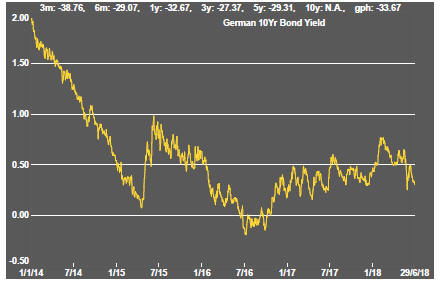

US 10 year bond yields remained under the 3% barrier helping to shore up equity market prices.
Market rates have generally eased with less concern about European fiscal conditions and, within that trend, a continuing demand for less risky assets such as those of Germany and the USA.
Lower German yields are acting as a constraint on US government bond yields despite the assumed near certainty of several further interest rate rises by the Federal Reserve.
Low rated corporate bond yields edged higher but remained at cyclically low levels.
Exchange Rates


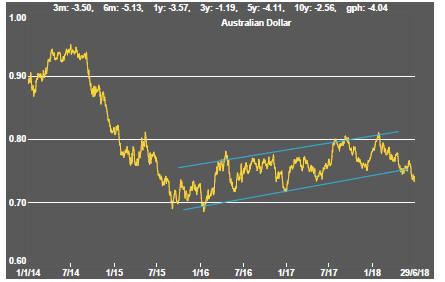
The euro has been fluctuating without a strong directional sense in contrast to several other leading currencies, inclosing the yuan and sterling, which have been pushing lower. The result is a strengthening bias for the US dollar which remains a retardant on commodity price moves.
A move lower by the Chinese yuan was more dramatic. The lower currency would give export oriented Chinese companies some breathing space against pressures from a tariff battle with the US government.
Developing country exchange rates continued to face downward pressure. Individual differences in the causes of currency weakness have started to merge into a theme into which the Australian dollar has been pulled.
The Australian currency appears to have fallen out of an upward trend which dates from early 2016 as it has become a victim of the potential trade disruptions.
Commodity Prices

The general upswing in commodity prices since mid 2017 had been given added impetus by stronger crude oil prices.
Prices remain within the bounds of a cyclical trough, albeit at the upper end.
The flip side of the benefits for commodity producers and exporters of higher commodity prices is the cost pressure now being experienced by users of agricultural and raw material commodities. Reporting companies have been suggesting this as a source of margin compression.
Business surveys closely watched by central banks are showing signs of upward pressure on selling prices as a result of higher raw material prices.
Gold & Precious Metals
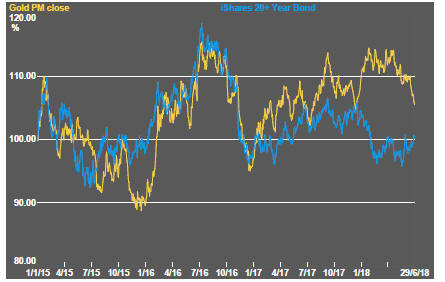


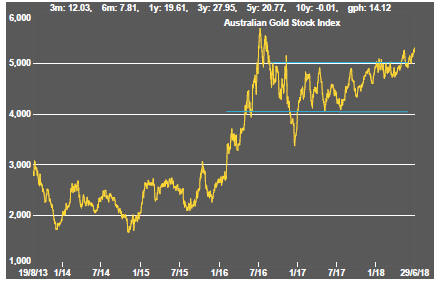
Across the precious metal sector, prices have broken through the bounds of prior trading ranges.
Gold and palladium price uptrends have been broken. Platinum prices fell below the lower bound of a two year trading range. Silver prices proved the most resilient in staying within its trading range.
The divergence in trend between Australian and north American gold related equities remains evident with US markets more aligned with a sceptical view of the near term future of precious metal prices and the Australian market helped by a weaker Australian dollar.
Nonferrous Metals


Metal prices remained on a downward trajectory at the end of the week amid signs of poorer than previously expected growth outcomes and, somewhat related, concerns about the effect of a trade clash between the US government and most of its major trading partners.
Nickel prices remain relatively strong. Tin prices are relatively weak. Others of the main daily traded nonferrous metals are once again converging as a result of being driven by a similar set of macro forces, including a rising US dollar.
Scepticism about the growth trajectory embedded in bond yield movements is now also being reflected more clearly in copper prices which remain consistent with a cyclical turn although it might be too early to draw a firm conclusion about that from recent price action which has kept copper price movement within a 12 month trading range.
Bulk Commodities

Relatively weak first quarter Chinese GDP growth had suggested a ramp up in activity through the remainder of 2018 if China was going to meet its growth target which, in a centrally controlled economy in which leaders are trying to maintain credibility, is a reasonable assumption.
Iron ore prices have failed to reflect the ongoing expansion in Chinese manufacturing output although coal and steel prices have been climbing.
Oil and Gas


Crude oil prices had reached the highest levels in several years before breaking lower after comments from major producers that a production increase might be contemplated and reports of Russian president Vladimir Putin saying that a $60/bbl oil price would be adequate.
The sharp market response to the slightly more bearish tone might have led to some reconsideration of any plans to push output higher.
While a meeting of OPEC members decided to expand production, the size of the increase was less than had been expected leading to a sharp rise in prices.
The push by the US administration to re-impose economic sanctions on Iran is also working to put upward pressure on oil prices. The Iranians are lobbying European countries to prevent more widespread application of sanctions but the likelihood of relief appears slim as long as funds must circulate through US banks.
US production, in any event, continues to rise and is now matching output from Russia and Saudi Arabia.
Against a backdrop of weaker equity markets, the corporate beneficiaries of higher oil prices have not generally seen their earnings sensitivity to higher prices reflected in share price changes.
Battery Metals


Eighteen months of rising lithium-related stock prices gave way to a period of market reassessment as a lengthy pipeline of potential new projects raised the prospect, although not conclusively, of ongoing supplies being adequate for expected needs.
Potential lithium producers have been able to respond far more quickly to market signals than has been the case in other segments of the mining industry where development prospects have been slowed by reticence among financiers to back development.
Movements in lithium related equity prices have been aligned more closely with overall sector equity prices in recent weeks.

Battery metals remain a focal point for investors with recent attention moving to cobalt and vanadium.
Doubts about a peaceful transfer of political power in the Democratic Republic of the Congo (and an Ebola outbreak) had added a dimension to cobalt prices lacking in other metals caught up in the excitement over transport electrification. Improved political conditions leave cobalt prices at risk of some retracement.
In the longer term, cobalt is the most vulnerable of the battery related metals to substitution with high prices likely to stimulate research in that direction.
Uranium


The uranium sector is forming a cyclical trough as market balances slowly improve. Power utilities are still not prepared to re-enter the market for contracted amounts of metal to meet longer term needs. A slight upward bias in prices was evident in the past month.
Slightly higher equity prices from time to time, in the hope of improved conditions, have not been sustained but could be repeated as speculation about improved future demand ebbs and flows.
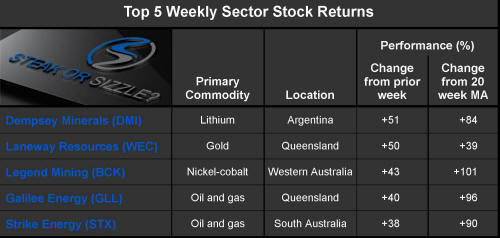
The Steak or Sizzle? blog LINK contains additional commentary on the best performed stocks in the sector and the extent to which their investment outcomes are underpinned by a strong enough value proposition to sustain the gains.

